
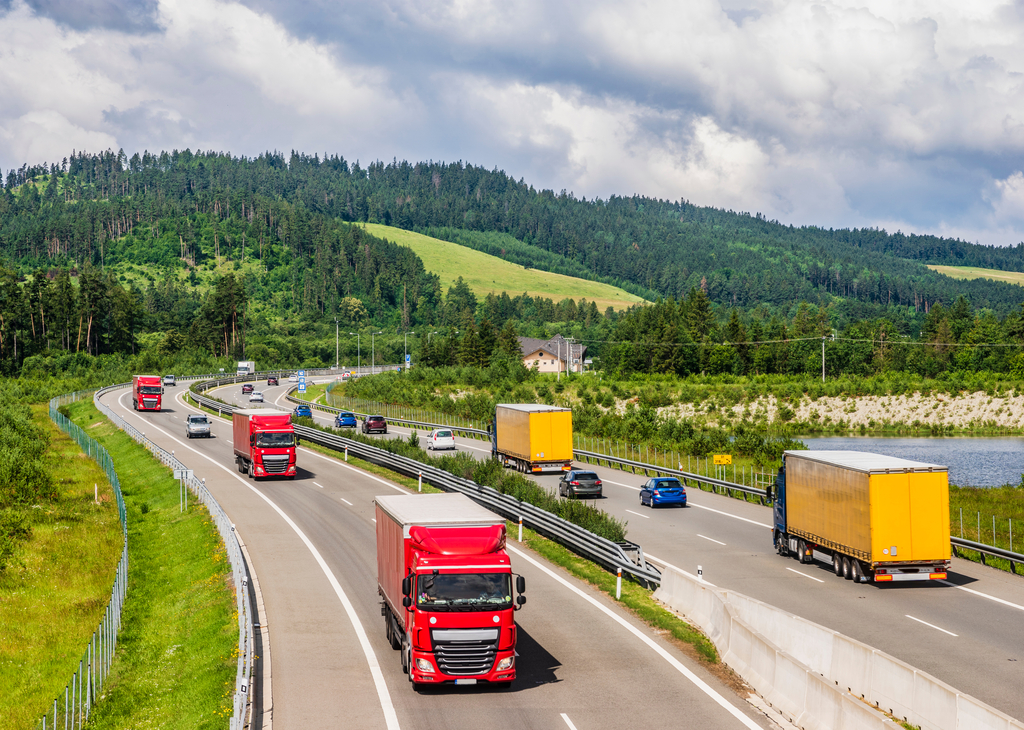
Netherlands launches kilometre-based truck toll
The Netherlands has launched its new kilometre-based truck toll, replacing the Eurovignette for heavy goods vehicles using Dutch roads.
The vrachtwagenheffing, or truck toll, came into force on 1 July 2026 and applies to Dutch and foreign trucks in vehicle categories N2 and N3 with a technical maximum mass of more than 3.5 tonnes. The charge applies on almost all Dutch motorways and on selected provincial and municipal roads. Truck owners now pay per kilometre driven, with the charge calculated according to vehicle weight, CO₂ emissions class and, in some cases, Euro emissions class.
The Dutch government said the introduction of the toll marks the end of the Eurovignette in the Netherlands, while fixed taxes for trucks are being reduced. Motor vehicle tax has been abolished for trucks up to 12 tonnes, while the tax for heavier trucks is being reduced to the European minimum level. A temporary zero rate applies for heavier trucks from 1 July 2026 until 1 January 2027.
Vincent Karremans, minister of infrastructure and water management, said: “After years of preparation, the truck toll has been introduced today. The majority of the revenue will flow back into the sector. Thanks to this ‘reflux mechanism’, the electrification of the sector can be accelerated.”
Karremans said the approach would improve air quality, reduce CO₂ emissions and help make the transition to electric trucks a stronger business case for transport companies. Under the scheme, trucks must be equipped with a functioning onboard unit (OBU) linked to a contract with an approved toll service provider. The OBU records distance travelled on the charged road network, with the provider handling payment and settlement.
Approved European Electronic Toll Service providers include TotalEnergies, Telepass, Toll4Europe, Axxès, Tolltickets and Eurowag. NedLinq also provides OBUs that work only in the Netherlands. RDW, the Dutch vehicle authority responsible for toll collection, had approved Eurowag as the sixth EETS provider in June, following earlier approvals for TotalEnergies, Telepass, Toll4Europe, Axxès and Tolltickets.
Jan Strijk, toll collection director at RDW, said at the time: “With Eurowag, all providers that registered last year for the Dutch truck toll have now been admitted.” Battery-electric trucks are not exempt from the new charge, but pay the lowest rates because they fall into CO₂ emissions class 5. According to the official tariff tables, from 1 July to 1 September 2026, a CO₂ class 5 truck of more than 32 tonnes pays €0.038 per kilometre, while a comparable truck in CO₂ class 3 pays €0.165 per kilometre.
Across the full tariff structure, rates from 1 July to 1 September range from €0.025 per kilometre for the lightest CO₂ class 5 vehicles to €0.487 per kilometre for the heaviest, highest-emitting vehicles in CO₂ class 1 and Euro 0. A temporary 22.3% discount will apply to truck toll tariffs from 1 September to 31 December 2026. The Dutch government said the reduction was introduced at the request of the House of Representatives to provide temporary relief to the road transport sector because of higher fuel costs linked to the conflict in the Middle East. Enforcement began from the launch date. Trucks in scope must have a working OBU while driving in the Netherlands, and operators without one can be fined.
During the first six months, fine amounts will be halved as part of an adjustment period.
RDW has also introduced a short grace period for truck owners who applied for an OBU before 1 July but had not received it in time. Those operators will not be fined in the first week of the scheme, up to and including 7 July, provided the issue has been reported through their service provider.
A large part of the revenue from the truck toll will be returned to the Dutch road transport sector through subsidies for electric trucks, charging infrastructure and more efficient transport. The AanZET subsidy programme for zero-emission trucks is due to reopen on 29 September, with €119.2m available for the next funding round.